
February 2026
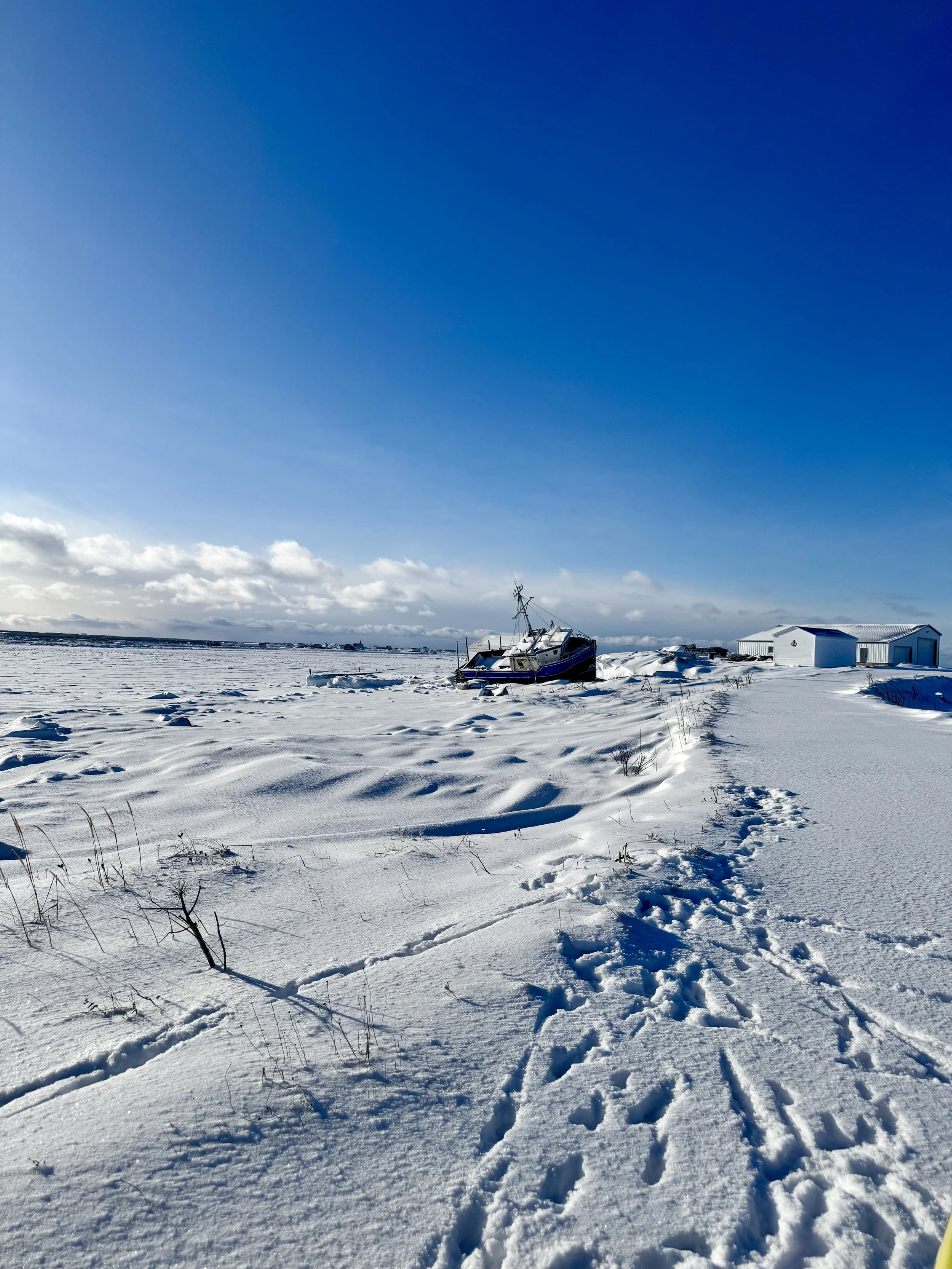
Winter in Nameless Cove on the Great Northern Peninsula

Message from our Executive Director
February 2026
It is incredibly exciting to share the second edition of the Great Coastal Trail newsletter. Over the past months, meaningful work has been unfolding — partnerships taking shape, plans moving forward, and early milestones being reached. This issue offers a snapshot of that progress, but more importantly, it offers a moment to pause and reflect on why this work matters.
Before going any further, we want to extend a sincere thank you. Thank you for reading, for following along, and for caring about this place and the people who call it home. Whether you are a volunteer, a community partner, a supporter, or someone who simply feels connected to the Northern Peninsula, your attention and engagement are deeply appreciated.
As the Great Coastal Trail begins to move from vision to reality, it has prompted many conversations — about community, opportunity, resilience, and responsibility. It has also brought us back to some difficult but necessary truths about the challenges northern communities continue to face, particularly for young people growing up with isolation, limited opportunity, and few reasons to feel hopeful.
Recently, I spoke with someone living and working in the North. Our conversation turned to the weight many young people are carrying — the deep sense of isolation, the lack of opportunity, and the way alcohol, drugs, and disconnection continue to impact northern communities. In just one recent month, there were eight tragic losses. Eight lives. That number alone speaks volumes.
Communities across Labrador and Newfoundland know this reality well. Generations have felt the pull of distance, obligation, and leaving, sometimes by choice, sometimes by necessity. Many of us grew up surrounded by beauty, resilience, and tradition, but also by hardship, silence, and struggle.
For many people, myself included, the outdoors became a refuge — a place of steadiness when other parts of life felt uncertain. Long days spent outside. Exploring coastlines and barrens. Following old paths carved by animals, by ancestors, by time itself. These places offered perspective, grounding, and a sense of belonging when little else did.
Trails, paths, and open land have always been more than routes from one place to another. They are where stories were passed, food was gathered, boats were hauled, berries were picked, and communities quietly took care of one another. They are woven into who we are.
This is not to suggest that a single project can solve deeply rooted challenges or change the course of every life, we know times are different now, and the realities facing young people today are complex. But it doesn’t mean we can’t try.
We can take what has been entrusted to us — our shared history, our landscapes, and the resources we have today — and use them thoughtfully. We can create spaces that invite connection, pride, movement, and possibility. We can preserve what matters and share it in ways that strengthen communities rather than erode them.
The work ahead is not about quick fixes. It is about creating places where meaning lives — places that hold memory, invite participation, and remind us of who we are.
And that work has always taken a village.
As you move through the rest of this newsletter, you’ll see how these reflections are already taking shape in practical ways — through new partnerships, tangible progress on the ground, and thoughtful planning for what comes next. Each update represents another step forward, another connection made, another piece of work carried by many hands. None of it stands alone, and all of it is guided by the same intention: to build something meaningful, respectful, and lasting for the communities of the Northern Peninsula.
Yours, From the heart
Erika Pardy
Executive Director
Great Coastal Trail Authority
If this story resonates with you, we invite you to stay connected.
Share this journey. Talk about it in your community. Walk a trail. Tell a story. Support the work in whatever way feels right to you.
Every step forward — no matter how small — helps keep this legacy alive.
About the Great Coastal Trail Authority (GCTA)
The Great Coastal Trail Authority (GCTA) is a non-government organization (NGO) and a non-profit entity.
This means:
GCTA is not a government department, agency, or division
GCTA does not represent the government
GCTA does not have regulatory or enforcement authority
Like many community and economic development organizations across Newfoundland and Labrador, GCTA receives government funding to support public-interest work. However, receiving public funding does not make GCTA a government body.
GCTA operates independently, with its own:
Governance and Board of Directors
Mandate and strategic priorities
Partnerships and decision-making processes
Our role is to support, coordinate, and amplify community-led trail development, not to control it. We work alongside municipalities, development organizations, volunteer trail groups, and residents — always with respect for local leadership, ownership, and voice.
The Great Coastal Trail is being built through collaboration, not government directive, and through partnerships that honour the work communities have already done.
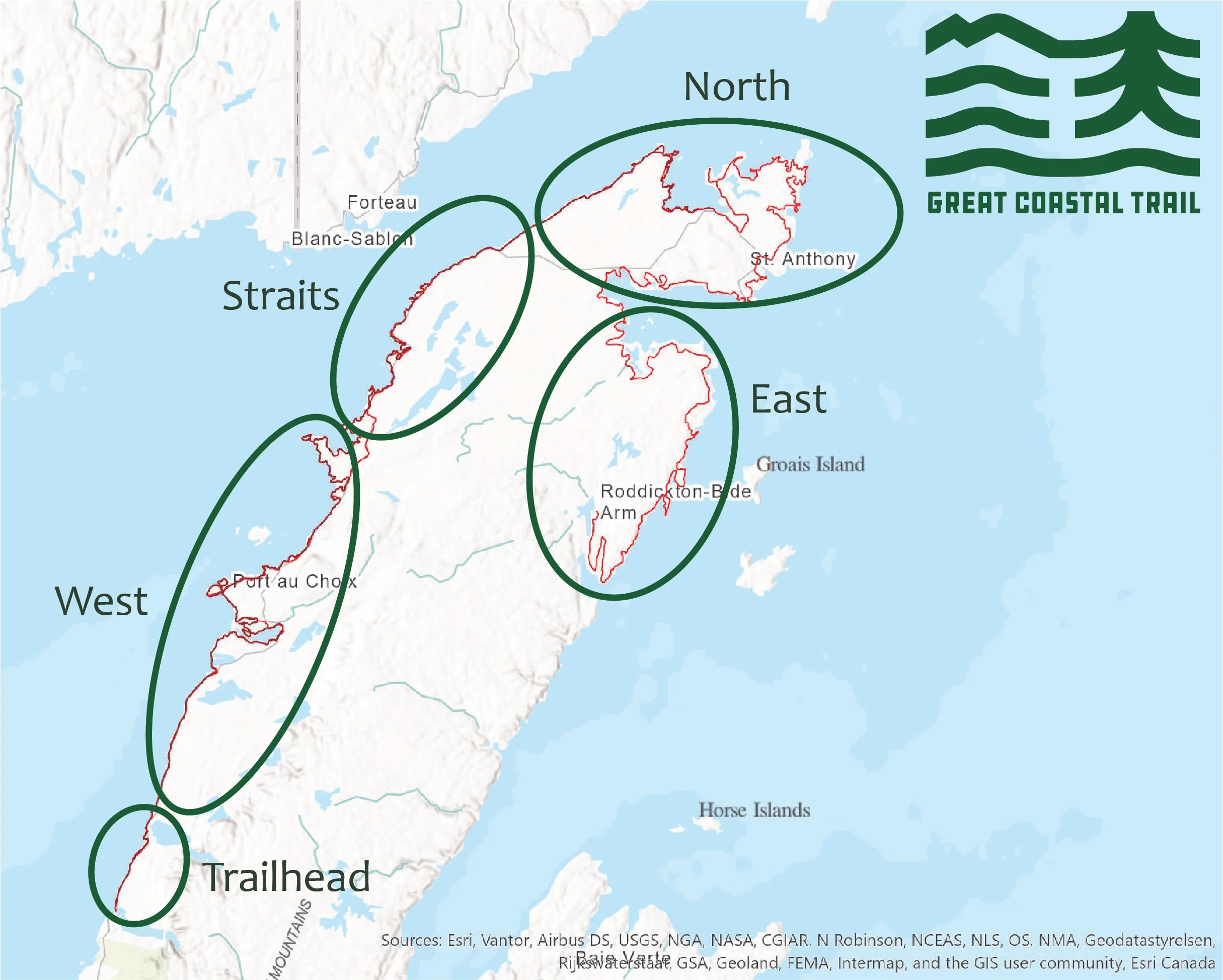
Partnership and Progess Update
The Great Coastal Trail Authority (GCTA) continues to advance strategic partnerships across the Great Northern Peninsula to support the planning, regulatory approval, and long-term development of the Great Coastal Trail. These partnerships ensure regional alignment, regulatory compliance, and strong community representation throughout all phases of trail development.
Regional Council Collaboration – Tri-Town Area
Communities represented: River of Ponds, Port au Choix, Port Saunders, Hawke’s Bay
Key progress and activities:
Ongoing collaboration with municipal leadership to identify and confirm priority trail corridors
Preparation and coordination of License to Occupy (LTO) applications to formalize land access
Alignment of trail planning with municipal and regional economic development priorities
Establishment of partnership frameworks to support long-term stewardship, maintenance, and sustainability
Strategic importance:
These communities represent critical coastal connectors within the broader Great Coastal Trail network
Provides essential continuity between western and northern trail segments
Town of Main Brook and Main Brook Research and Development
Key progress:
Formal partnership established with the Town of Main Brook and Main Brook Research and Development to develop the Grenfell Memorial Trail section of the Great Coastal Trail
First License to Occupy (LTO) application and Environmental Assessment Registration has been submitted for a 20 kilometer trail section of the Great Coastal Trail to the Northwest and Southeast of Main Brook
White Bay Central Development Association
Communities represented: Roddickton–Bide Arm, Main Brook, Croque, Crouse, Conche, Englee
Key progress and activities:
Formal partnership established with White Bay Central Development Inc. as regional development partner to establish the Northern terminus of the Great Coastal Trail Network
Identification and prioritization of additional trail corridors across White Bay communities
Ongoing coordination to ensure alignment with regional economic development and tourism strategies
Engagement with regional leadership to support long-term trail stewardship and sustainability
Strategic importance:
Establishes the northern foundation of the Great Coastal Trail network
Partnership with the St. Barbe Development Association (SBDA)
Regional representation:
St Barbe Development Association represents 17 communities from St Barbe to River of Ponds.
The GCTA and SBDA will work in partnership to cover the land area from St Barbe to Eddies Cove West.
Key progress and activities:
Formal partnership established with SBDA as regional development and coordination partner to identify priority trail routes and aligning trail planning with regional economic development, tourism, and sustainability objectives
Regional coordination model established to support efficient engagement across multiple communities
Preparation and coordination of License to Occupy (LTO) applications for priority trail corridors and Environmental Assessment registration preparation for sections where required
Establishment of long-term partnership framework to support stewardship and trail operations
Strategic importance:
Provides coordinated regional representation across a large and strategically important corridor
Strengthens trail connectivity along the western edge of the Great Northern Peninsula
Supports gateway access via marine transportation routes and regional infrastructure
Partnership with the Great Northern Trail Association (GNTA)
Key progress and activities:
Active collaboration with the Great Northern Trail Association to align existing trail infrastructure with the Great Coastal Trail network
Identification of opportunities to integrate and connect existing and future trail corridors
Coordination on land access considerations and regulatory requirements
Development of cooperative frameworks to support shared trail development and stewardship objectives
Strategic importance:
Ensures continuity between established trail infrastructure and future trail development
Strengthens regional trail cohesion and user experience
Builds upon existing trail investments and legacy infrastructure
These partnerships represent critical foundational progress in the development of the Great Coastal Trail and reflect the strong regional support and cooperation necessary to bring this vision forward.
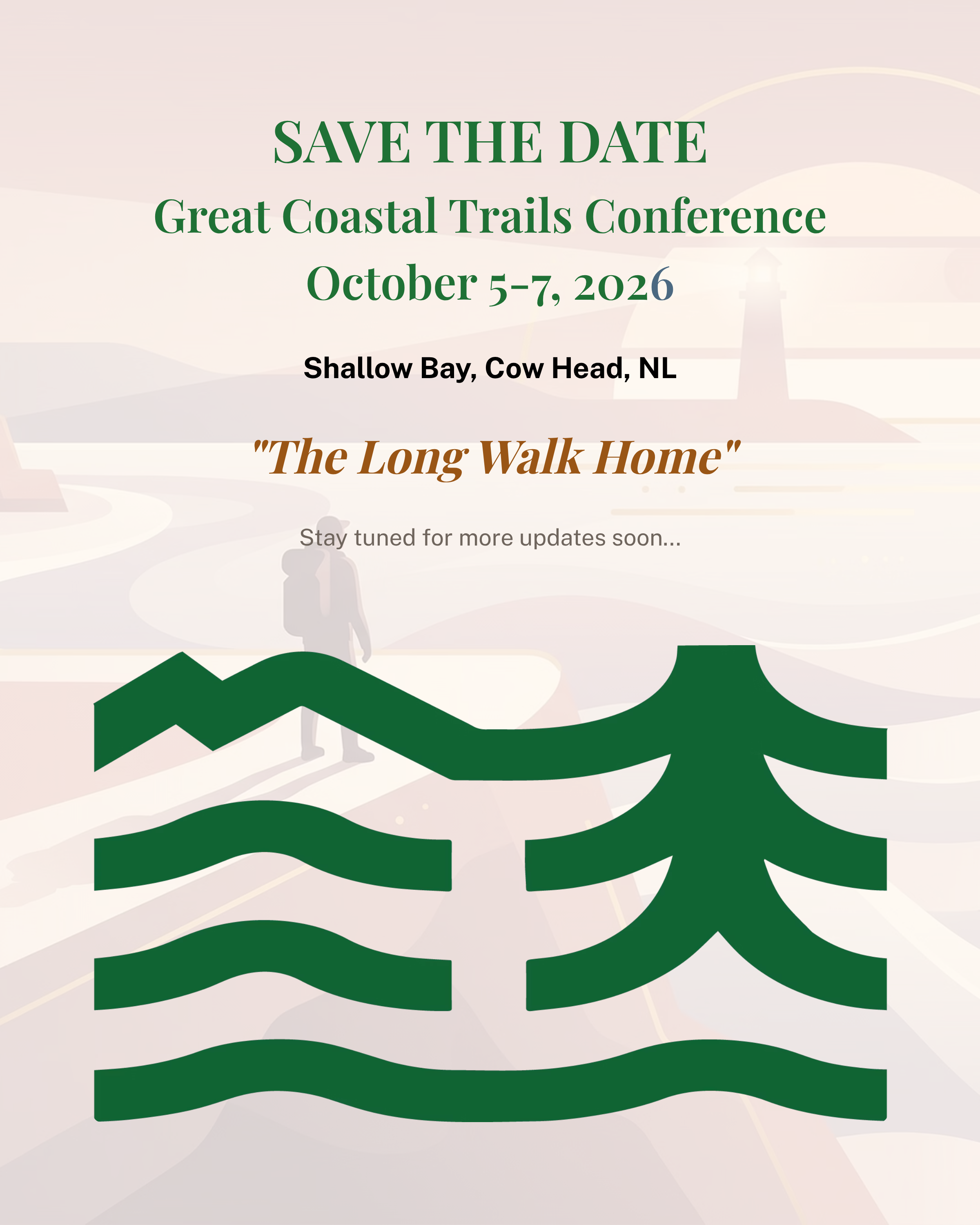
Save the date for the Great Coastal Trail Conference “The Long Walk Home”! October 5-7, 2026 in Cow Head, NL. More information will be coming very soon!
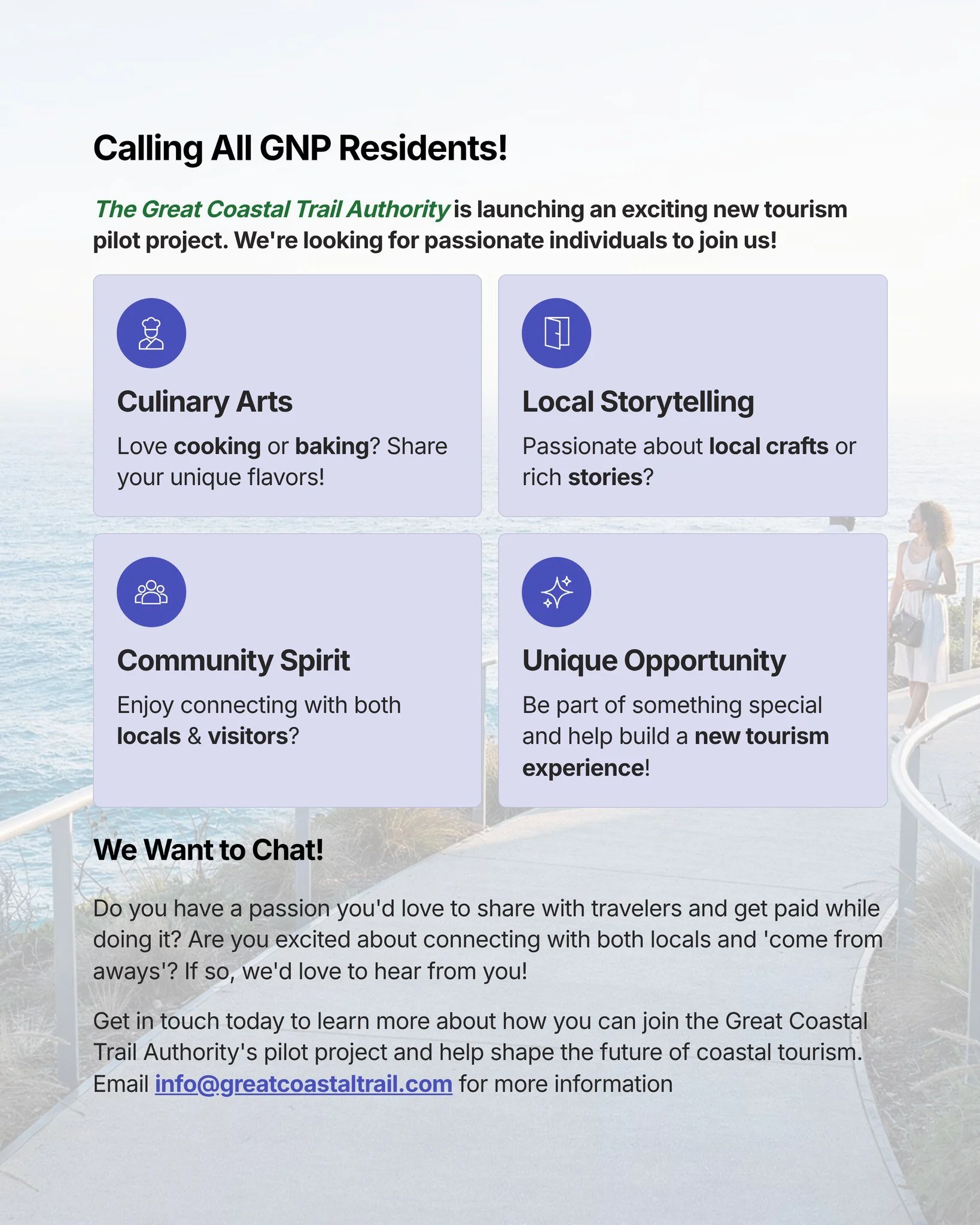
The GCTA is looking for people all across the GNP for a new pilot project. This project will help share and preserve our culture and heritage skills and earn money while doing it. Send an email to info@greatcoastaltrail.com for more information on this exciting project!
Community Voices
”The Capstan: Manpower and Ingenuity”
Information shared by Peter Woodward, compiled and written by Erika Pardy
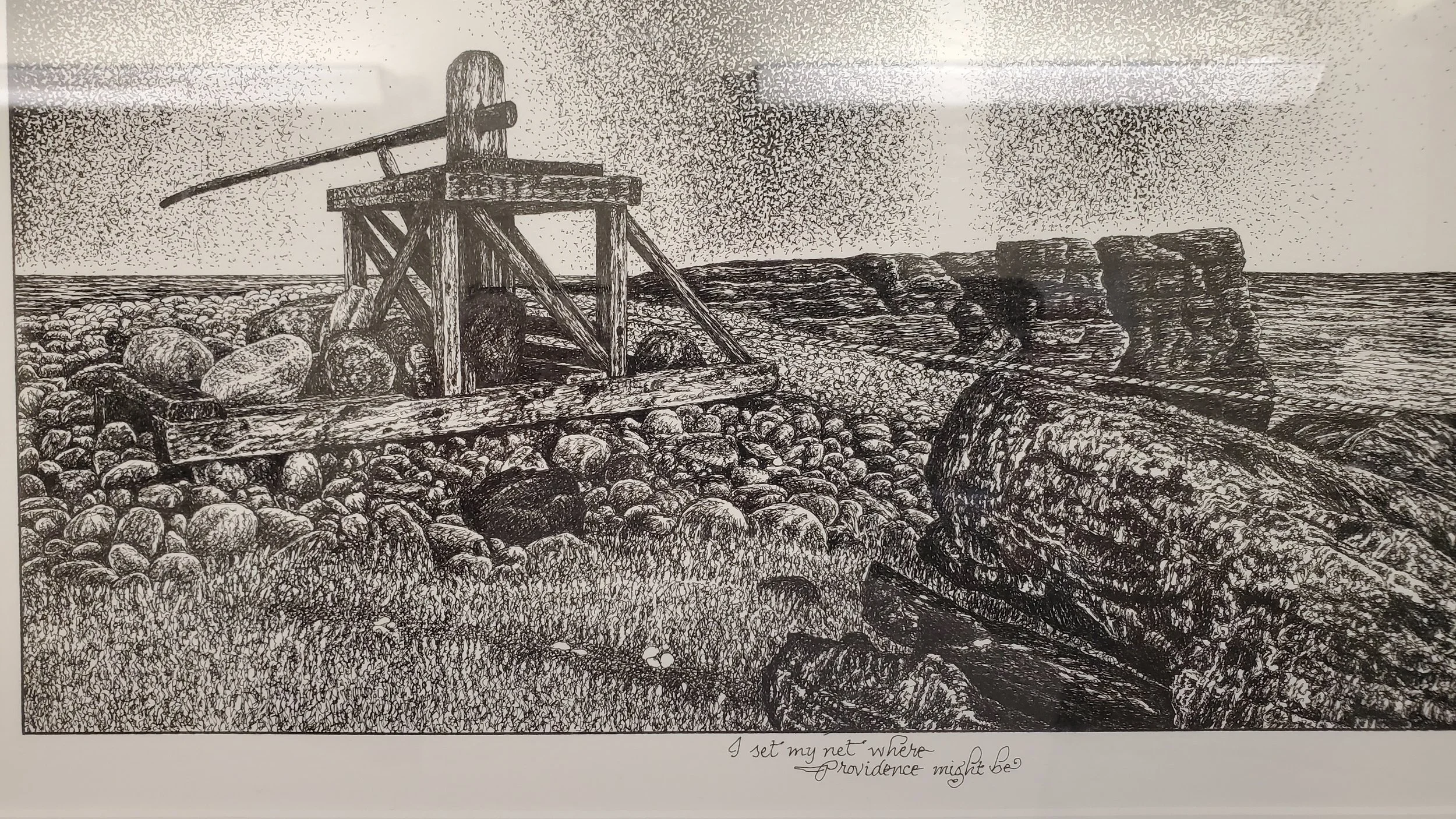
Artist Boyd Chubbs rendition of a capstan
There was a time along the French Shore when survival was not theoretical, and it wasn’t about policy. There were no funding streams or feasibility studies. It was a boat that had to be hauled above the tide before the wind shifted east. It was nets heavy with cod and seal that had to be lifted before rot or weather claimed them. It was the difference between keeping what you earned and watching it disappear back into the North Atlantic.
And at the centre of that effort stood something deceptively simple: the capstan.
If you were raised in one of these harbours along the Strait of Belle Isle, the very places written about in those early French Shore accounts, you would know that the coastline does not bend easily. The coves are honest, the beaches are made of stone, not sand. The surf is not sentimental or forgiving. Everything that stayed on land stayed there because someone fought to keep it.
A capstan was not elegant machinery. It was a vertical timber post set firm into rock and earth, crowned with a head that held wooden bars. A rope wound around its body. And then men leaned in, boots grinding into gravel, shoulders squared against the wind, and walked in a slow, deliberate circle.
They did not rush it. You could not rush it. A capstan teaches patience because physics does not respond to panic. It responds to steady pressure, to coordination, to the quiet intelligence of leverage. The men would push, reset, push again, their movement as circular as the tide itself, until a boat that looked immovable began to inch its way toward safety.
There is something deeply Newfoundland in that motion. We do not always overpower the thing in front of us. We outlast it.
The French Shore settlers described in the historical record were not engineers by trade. They were fishermen, Scots and English families carving out permanence on contested coastlines, raising children where France once fished and Britain negotiated. Yet they understood torque and friction long before they used those words. They understood that strength is multiplied when shared. They understood that wood, properly set, could hold against Atlantic force.
Capstans were built from what was at hand, spruce cut from inland barrens, iron fittings salvaged or forged with care, rope thick enough to trust with your livelihood. They were planted near fishing stages and at the working edge of the harbour, where land met labour. That phrase is not poetic exaggeration, it is about geography, the lay of the land. The working edge is where everything is tested.
If a capstan failed under strain, it did not simply inconvenience you. It could maim. It could destroy the very boat that fed your family. So, they overbuilt them. They braced them. They buried their foundations deep into rock and stubborn earth. Because the North Atlantic has never been impressed by optimism alone.
And yet these structures were not cold contraptions. They were touched daily. Children climbed on them when the work was done. Old men leaned against them while telling stories about winters so cold that it cracked beams and summers when the fish came in thick as the fog that blinded them. The wood grew smooth under hands that had salted nets and mended sails. A capstan was part of the rhythm of a harbour. It marked the place where community effort became visible.
You cannot operate a capstan alone, not when the load is heavy. It requires timing. It requires someone to call the pace. It requires bodies moving in unison, trusting one another not to falter mid-strain. In that way, it was less a machine and more a choreography of survival.
And if you stand on that same coast today, along the Great Northern Peninsula, where the wind still hunts the coves and the barrens still lean into the sea, you may find one leaning slightly, weathered by the elements but still present. A veteran of another era. Not decorative, except to those who ache for the past.
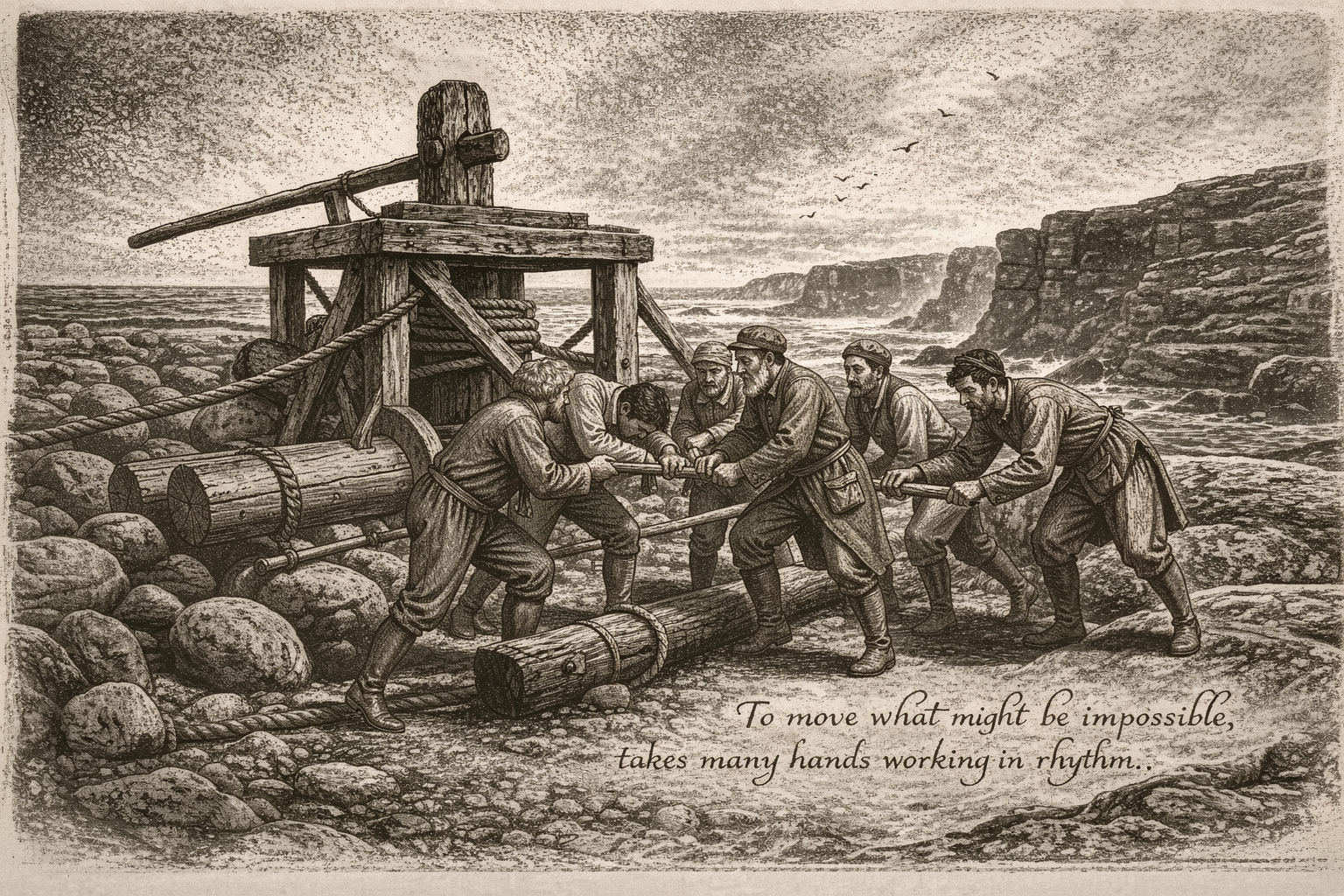
It is easy, in our time of hydraulics and diesel and quiet electric winches, to overlook what these wooden posts represent. But they are the physical expression of a principle that built this coast: leverage what you have, stand firm where you must, and move forward together.
The capstan did not conquer the sea. It negotiated with it. It acknowledged the weight of water and answered with circular persistence.
And there is something about that steady turning, that refusal to abandon what must be hauled home, that feels familiar still.
When we speak of revitalizing communities on the edge, we are not inventing a new story. We are stepping into an old one. We are remembering that infrastructure is not only concrete and policy; it is also timber and collective will. It is the willingness to walk in circles long enough for something heavy to move.
The capstan stands as quiet testimony that strength is rarely loud and deliberate. It is shared and it is anchored deep.
And along this coastline, where land meets infinity and the wind still presses its full weight against the shore, that lesson has never gone out of season.
Historical Fact!
There is a sub-genre of traditional British sea-shanties that are called “capstan shanties” that is because the were sung in unison by fishermen and dock workers to maintain the correct rhythm and timing of operating a capstan.
The well known song “Spanish Ladies” was a traditionally sung capstan shanty! Listen here
Memorial University, Grenfell Campus Student Projects
The GCTA is pleased to partner with students from Memorial University, Grenfell Campus as part of their Independent Community Project to complete a Certificate in Sustainable Rural Communities, under the supervision of professor Lynn Kendall. This course allows students to collaborate directly with rural organizations, governments, and non-profits to address real-world challenges and opportunities facing our region. We are excited to host two dedicated students this term and to share the projects they are completing with our team and community partners.
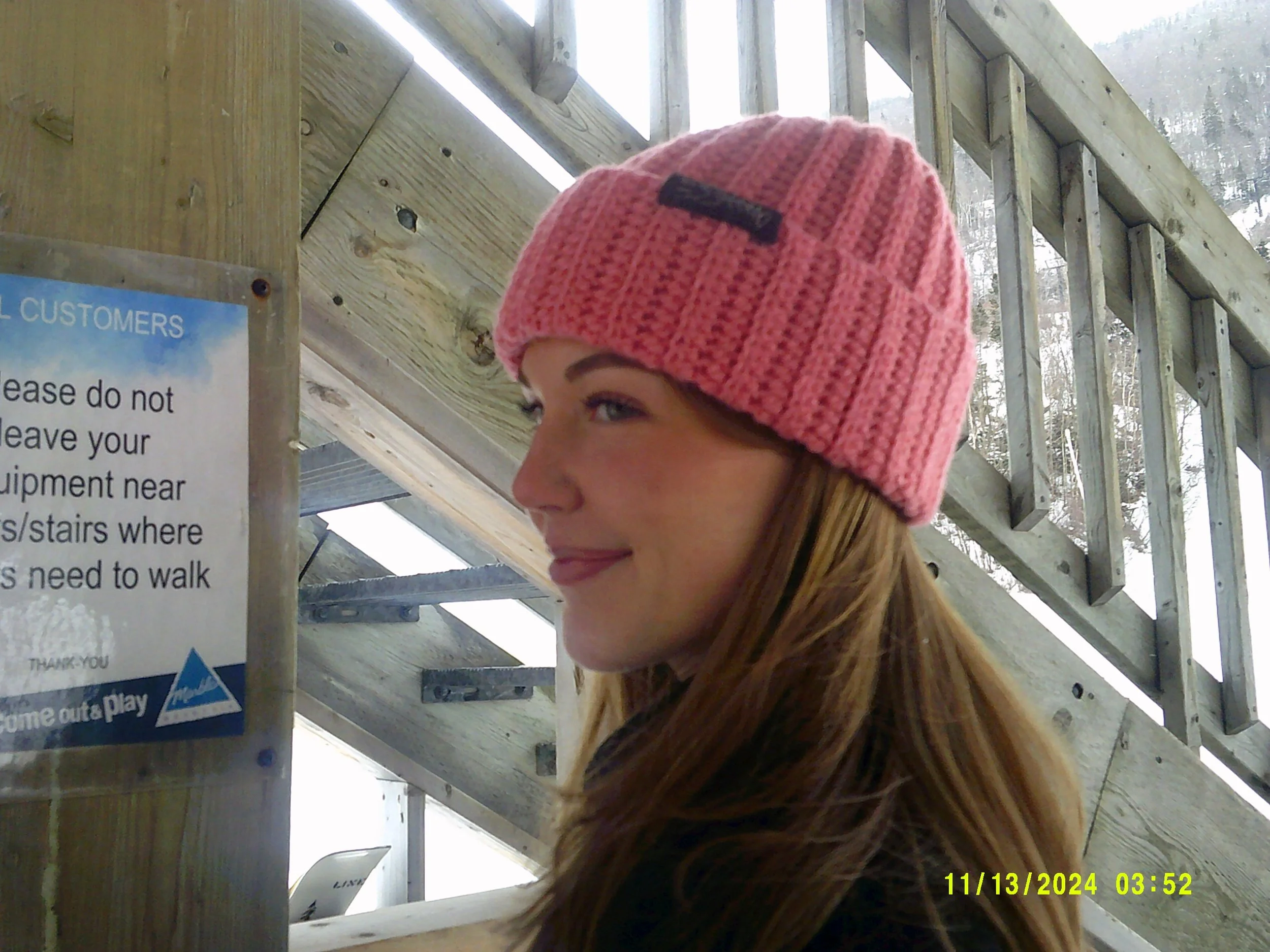
Hannah Budgell
Fourth Year student
Bachelor of Environment and Sustainability
Minor in Geography
My research project focuses on how wildlife conservation is integrated into decision-making for the Great Coastal Trail within a multi-jurisdictional context. I was interested in working with the Great Coastal Trail Association because the project closely aligns with my academic interests in environmental stewardship, sustainable rural communities, and community-based planning. It is exciting to contribute to an initiative that supports conservation while promoting responsible access to Newfoundland and Labrador’s unique coastal landscapes.
I am originally from St. John’s, NL, and I deeply value outdoor recreation. I enjoy hiking, spending time in the mountains, and skiing whenever I have the chance. Gros Morne National Park and the surrounding areas are some of my favourite places to explore, as they showcase the unique landscapes and wildlife that make this province so special.
Following graduation, I aspire to continue working with wildlife and the environment in a career that supports conservation and sustainable development. I am grateful for the opportunity to work alongside the Great Coastal Trail Association and look forward to contributing to a project that encourages people to experience and protect our natural spaces.
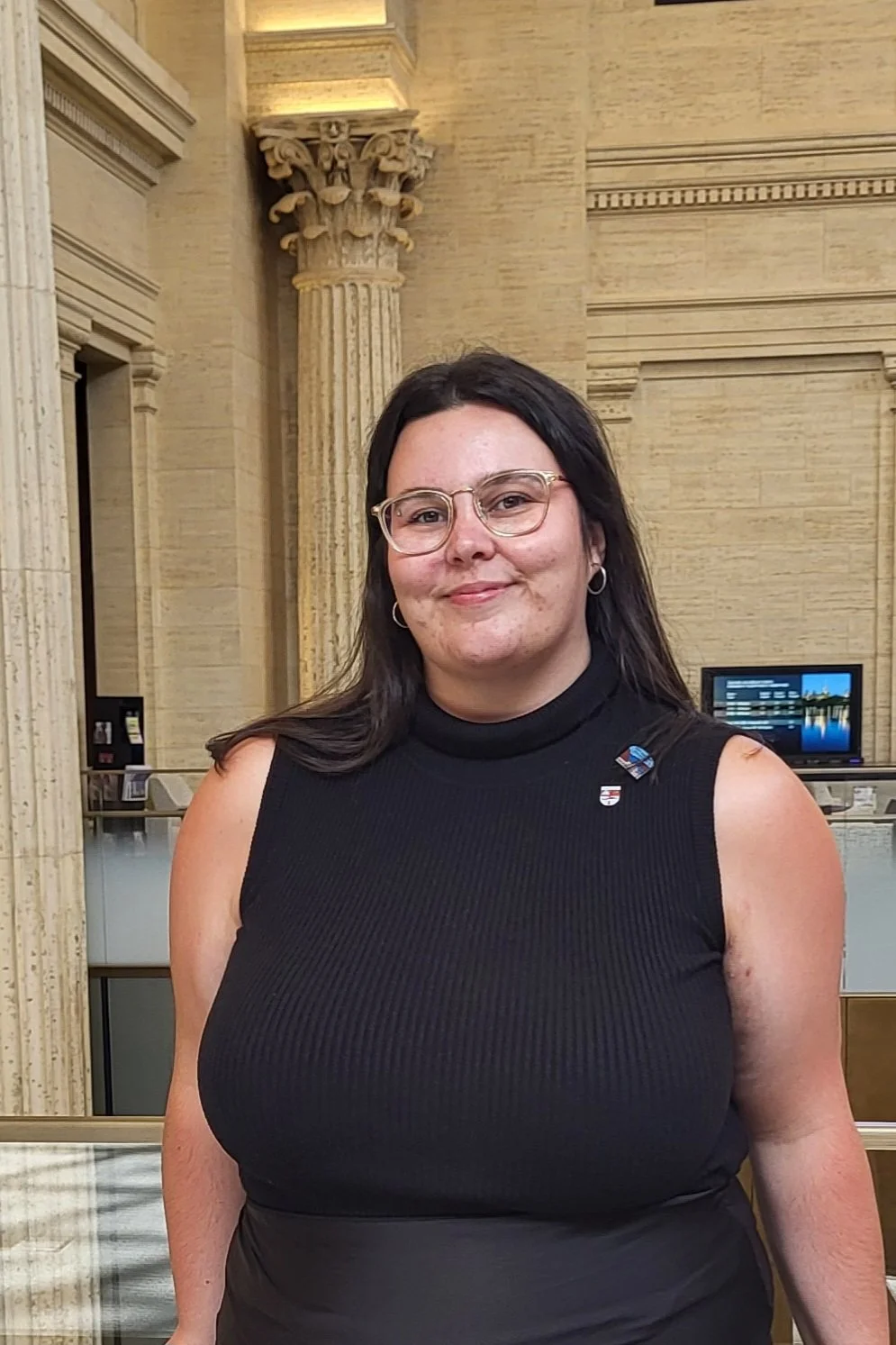
Jessica Warren
Fourth year student
Bachelor of Environment and Sustainability
Minor in Tourism Studies
My project with the GCTA will be gathering and compiling community, cultural, historical, and tourism assets along the Great Northern Peninsula. I will be conducting surveys this semester to create detailed profiles of each community along the Great Coastal Trail path. I am very excited to learn more about the incredible towns along the trail and help identify areas of opportunity!
My favorite place to explore is anywhere I can see the ocean or water. Sandbanks Provincial Park, in my hometown, is my favorite place to be and walk the trail. In my free time I am usually crafting, reading, or hoping for nice weather to get outside. Following graduation, I aspire to do something that allows me to combine my passion for politics, tourism, and the environment. I am looking forward to working on this project in my last semester of my undergraduate degree, and applying the skills I have learned to an important community project!

GCTA Staff and Contact Information:
Erika Pardy - Executive Director
epardy@greatcoastaltrail.com
Melissa Mills - Trail Design and Development
mmills@greatcoastaltrail.com
Lucas Garcia - Project Manager - Trails and Community
lgarcia@greatcoastaltrail.com
Hailee Keats - Office Admin and Partner Relations
hkeats@greatcoastaltrail.com
Send questions, comments, suggestions to
Info@greatcoastaltrail.com
Send submissions, stories, photos, recipes to
Heritage@greatcoastaltrail.com
